Bot mitigation
A bot score you can actually read.
Most bot products give you a number and ask you to trust it. Spalto's score is the sum of named signals, each with a rule ID and a weight. When a customer gets challenged, you can see exactly which signals did it.
How the score works
Signals in, steps out.
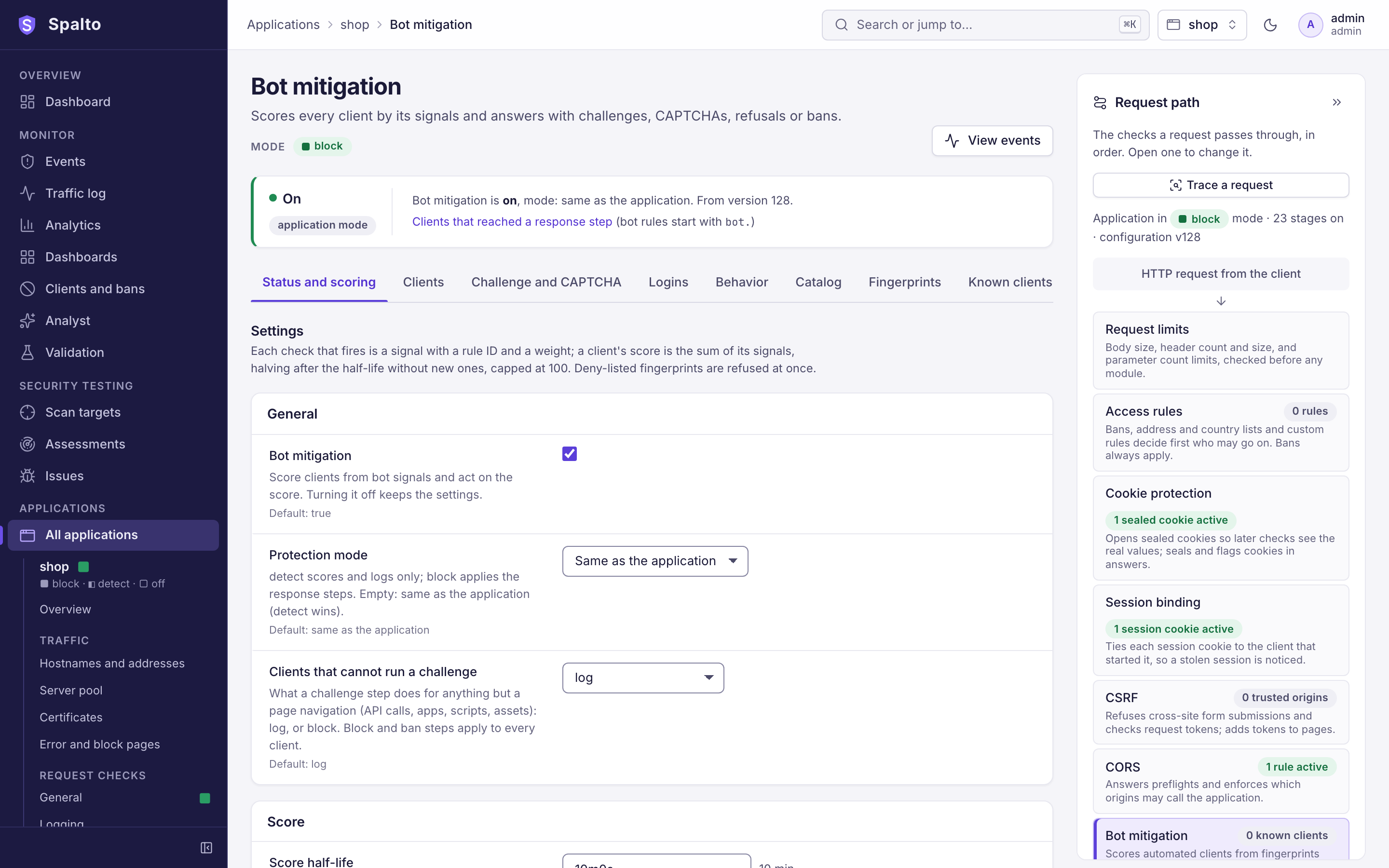
Each check that fires is a signal with a rule ID and a weight. A client's score is the sum of its signals, capped at 100. Without new signals, it halves after a half-life you set, so a client that behaves gets back to normal on its own.
You pick the response at each step. A fingerprint on your deny list is refused straight away.
Detection
How it spots automation.
- Behaviour
- Credential stuffing, brute force, scraping, scanning and enumeration.
- Fingerprints
- TLS (JA3, JA4) and HTTP (JA4H) fingerprints are counted per application. Known tools can be refused by fingerprint.
- Bot catalog
- Verified search engines, scanners and AI crawlers, checked by reverse DNS or published address ranges. Allow or refuse whole categories.
- Signed bots
- Cryptographic bot identity through signed HTTP requests.
Response
What it does about it.
Graduated, so the first answer to a borderline client is a challenge, not a ban.
- Escalation steps
- Set the score at which a client is challenged, sent a CAPTCHA, refused, slowed down (tarpit) or banned.
- Proof-of-work challenge
- A JavaScript challenge the browser solves by itself. Each solve costs the client real CPU time, which adds up fast for a bot farm. Or a third-party CAPTCHA you configure.
- Clients that can't run JavaScript
- API calls and scripts can't solve a challenge. You choose whether a challenge step logs or blocks them. Block and ban steps always apply.
- Exceptions
- Leave your office, your monitoring or a partner out of chosen bot rules, without turning bot mitigation off.
Want to put it in front of your own apps?
There's no public release yet. If you run web applications or APIs and want to try Spalto in a lab, or help shape it, write to us. A person answers.