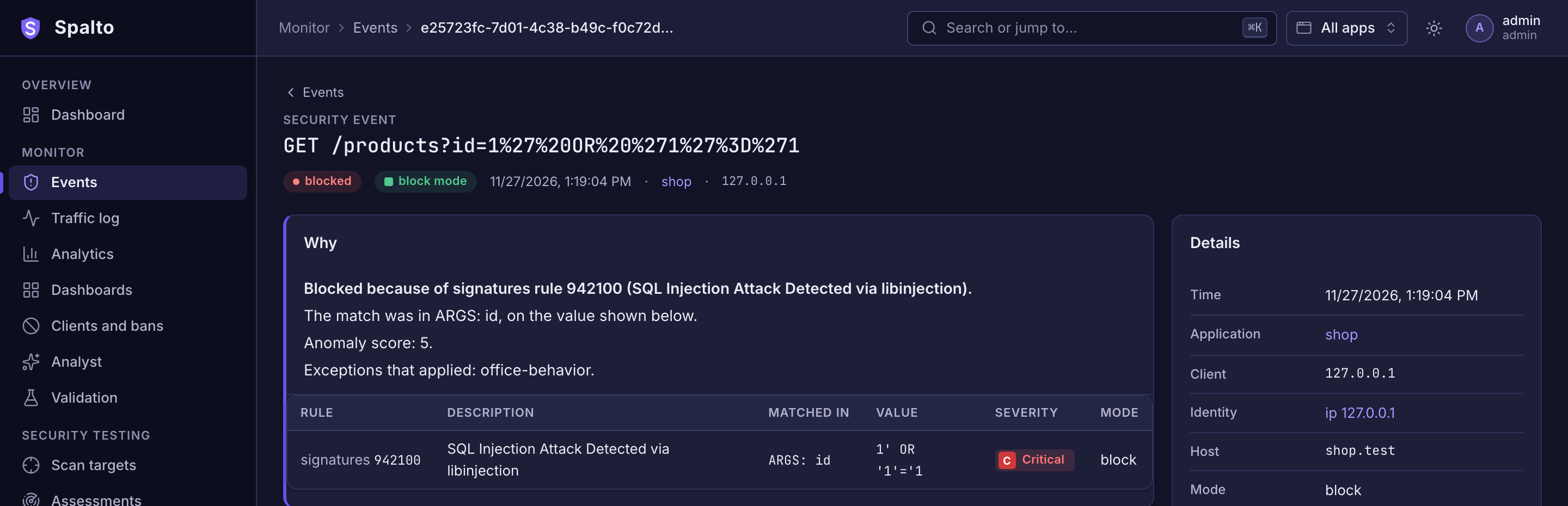
Every block comes with a reason.
Spalto is a web application and API firewall that runs on your own servers. When it stops a request, it shows you the rule, the field and the exact value that tripped it. A false positive becomes a quick, narrow fix instead of a reason to turn the firewall off.
Built on parts the industry already runs in production
- Envoy
- Coraza
- OWASP CRS v4
- RE2
- libinjection
- Go
The problem
Most WAFs end up in detect mode forever.
You probably know how it goes. A checkout request gets blocked on a Friday evening. The log says 403 and a rule number. Nobody can tell which part of the request matched, so someone switches the whole site to detect mode to stop the tickets. It stays that way.
Spalto is built around the opposite habit. Every decision is written down in words a person can read, with the value that caused it. The fix is an exception scoped to that one path and field, and you can undo it in one step.
The goal is simple: keep the firewall switched on.
Request flow
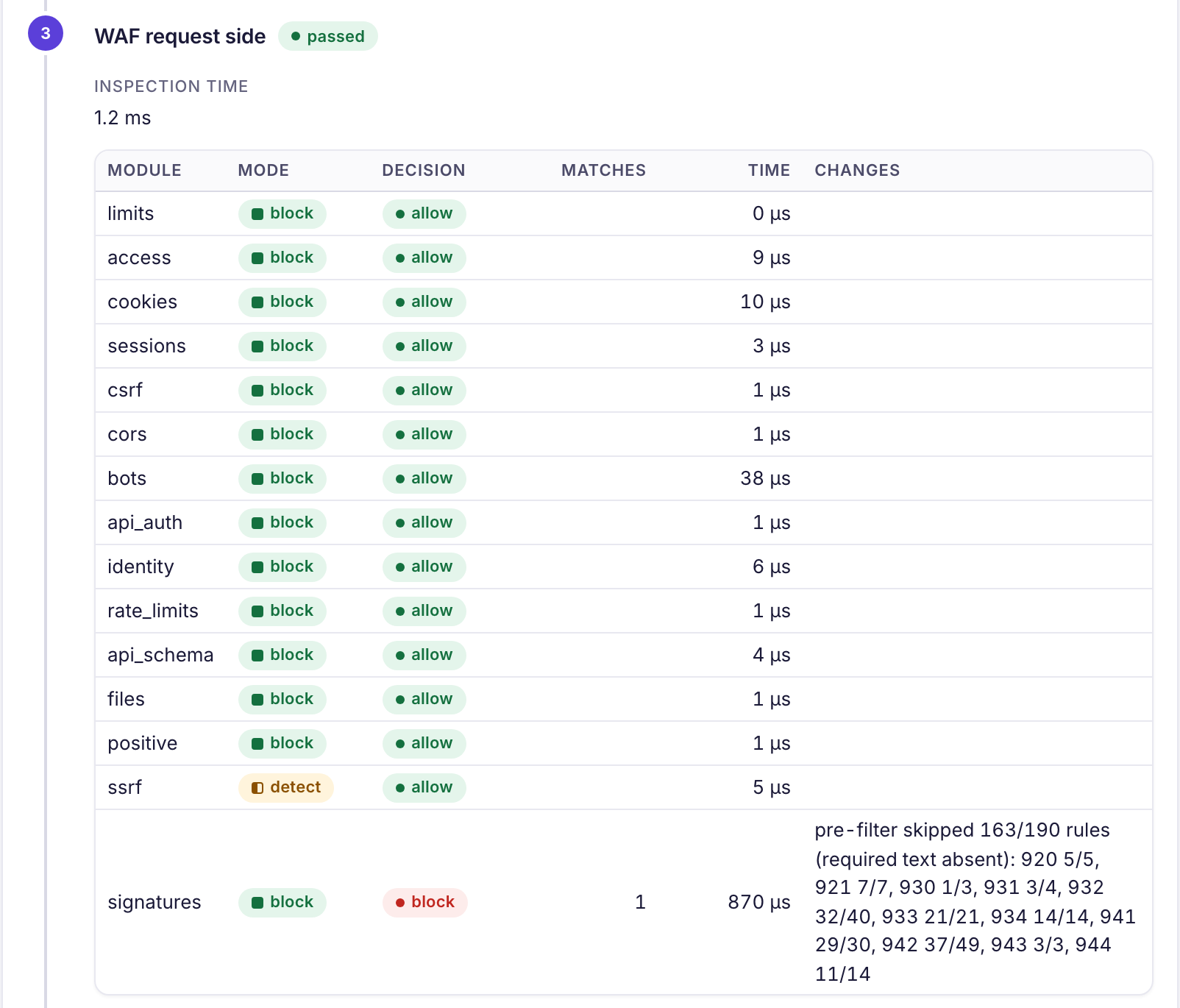
See every stage it ran, and how long each took.
Each event carries the full path of the request. You see every module in order, the mode it was in, what it decided and the time it spent, down to the microsecond.
So when something is slow or something gets through, you can point at the stage instead of guessing.
False positives
Fix it without opening a hole.
Click Propose exception on the event. Spalto drafts one as narrow as the event allows: this application, this path, the rules that matched and the field they matched in.
You read the change and add a note before anything applies. It goes in as a new configuration version, so rolling it back is one command.
The whole workflow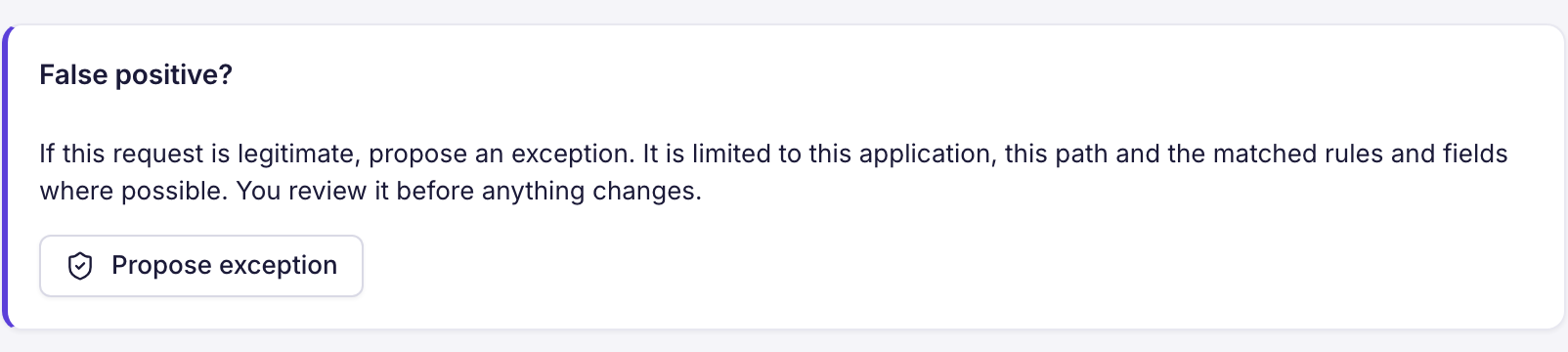
Rollout
Watch real traffic before you block any of it.
Run a whole application, or a single module, in detect mode. Events say would block and nothing is refused, so you tune on real requests first.
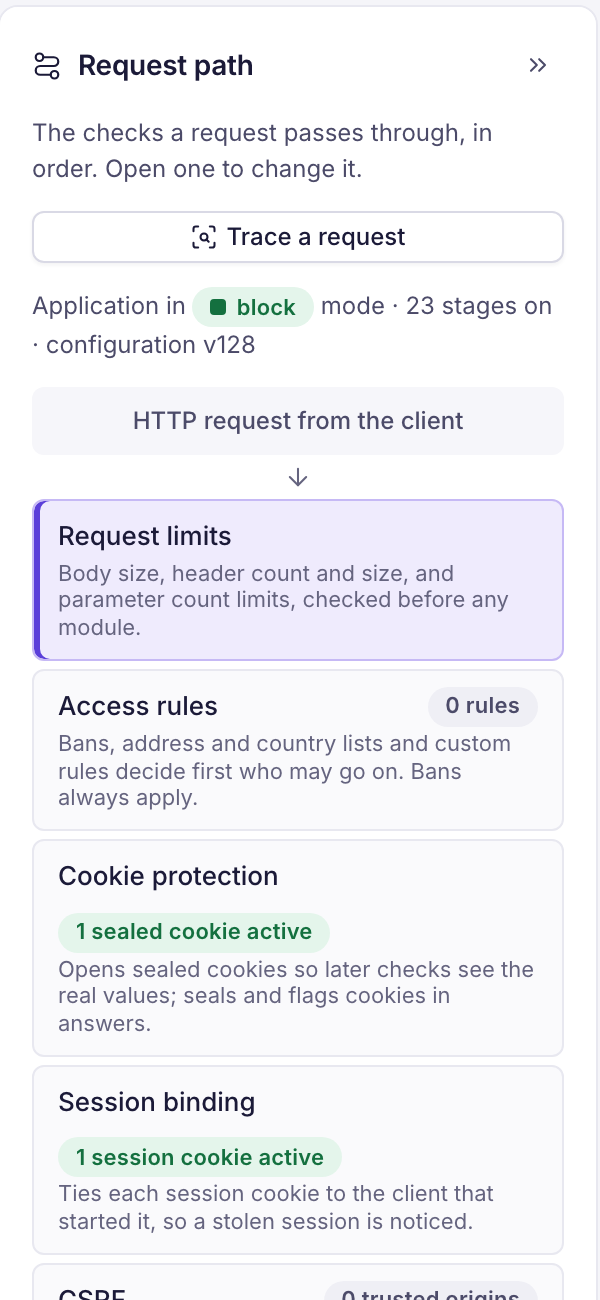
Every application also shows its request path: the checks a request passes through, in order, with what's on, what's off and what's only watching. You can trace a request through it, against today's configuration or an older one, without sending anything.
Coverage
One product for the whole request.
From the TLS handshake to the response body. Everything listed here works in the code today. The features page has the details, and a list of what's missing.
Web application firewall
OWASP Core Rule Set v4 in Coraza, your own rules, staged rules that only log until a date you pick, and exceptions as narrow as one field.
Learn more →API security
OpenAPI and JSON schema checks, JWT and API keys, GraphQL and gRPC limits, an endpoint inventory built from real traffic, and BOLA detection.
Learn more →Bot mitigation
A bot score where every signal and its weight is visible. Verified crawlers, a proof-of-work challenge, credential stuffing and scraping detection.
Learn more →Positive security
It learns each app's URLs and parameters and suggests a model. Nothing is enforced until you've reviewed it and approved it.
Learn more →Security testing
Runs the scanners you install, maps findings to CWE and OWASP, and turns them into virtual patches. Then scans again to check the patch holds.
Learn more →Operations
Web console, API and CLI. Three roles, SIEM export over syslog, Prometheus metrics, encrypted backups and an active/standby pair.
Learn more →
Architecture
Envoy in front. Our code decides. Nothing in the cloud.
We didn't write a proxy. Envoy handles connections and TLS, and asks Spalto's inspection service about each request over a local socket. The control plane pushes configuration to both and never touches live traffic.
Operating facts
- Runs on
- Linux with systemd. .deb and .rpm for amd64 and arm64, or containers.
- Failover
- Active/standby pair, 200 ms heartbeat, a 3-second failover target.
- TLS
- Hybrid post-quantum key exchange (X25519MLKEM768) offered first.
- Exports
- Syslog in JSON, CEF or LEEF over TLS. Prometheus metrics.
- Audit
- Hash-chained log of every change and every refused attempt.
- Phones home
- Never. No cloud service sits in the request path.
Open source
You should be able to read the code that guards your traffic.
The code is AGPL-3.0. The docs are CC BY 4.0. Our own detection rules are Apache-2.0, so you can lift them into other projects. Contributors sign off with the DCO, and there's no CLA to sign.
The public repository isn't open yet. Until it is, the best way in is an email saying what you'd like to work on.
Want to put it in front of your own apps?
There's no public release yet. If you run web applications or APIs and want to try Spalto in a lab, or help shape it, write to us. A person answers.