API security
Know every endpoint you expose. Enforce what each one should accept.
APIs don't fail like web pages. The dangerous request is often perfectly formed: the right shape, the wrong user. Spalto checks the contract, the caller and the behaviour, and builds an inventory from what it actually sees.
Inventory
An API inventory built from real traffic.
Spalto counts the endpoints your app actually answers: method, path template, errors, first and last seen. Undocumented (shadow) and unused (stale) endpoints stand out.
It learns a schema per endpoint from clean traffic. You review it, then enforce it or export it as OpenAPI. Nothing is enforced until you approve.
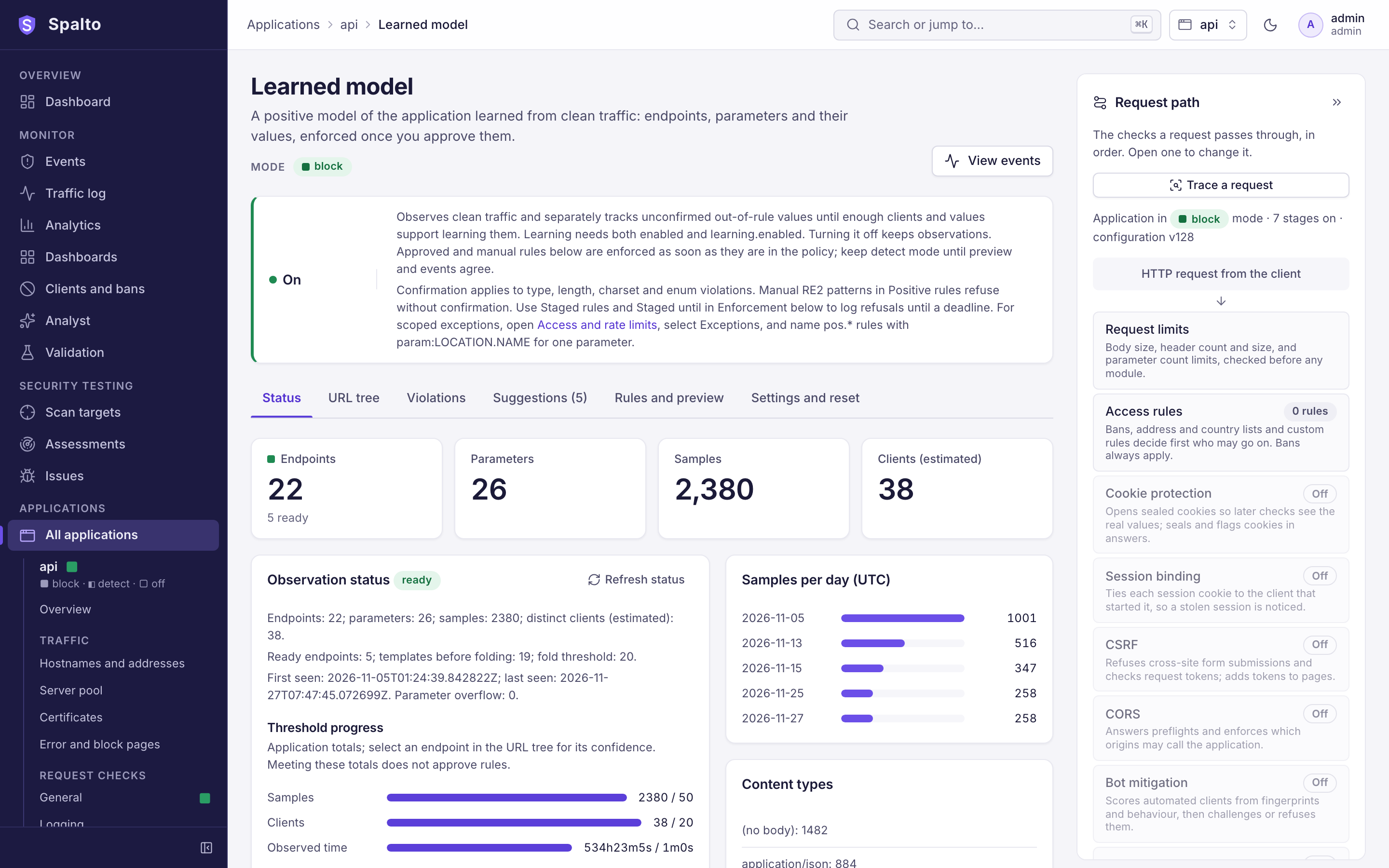
Per application
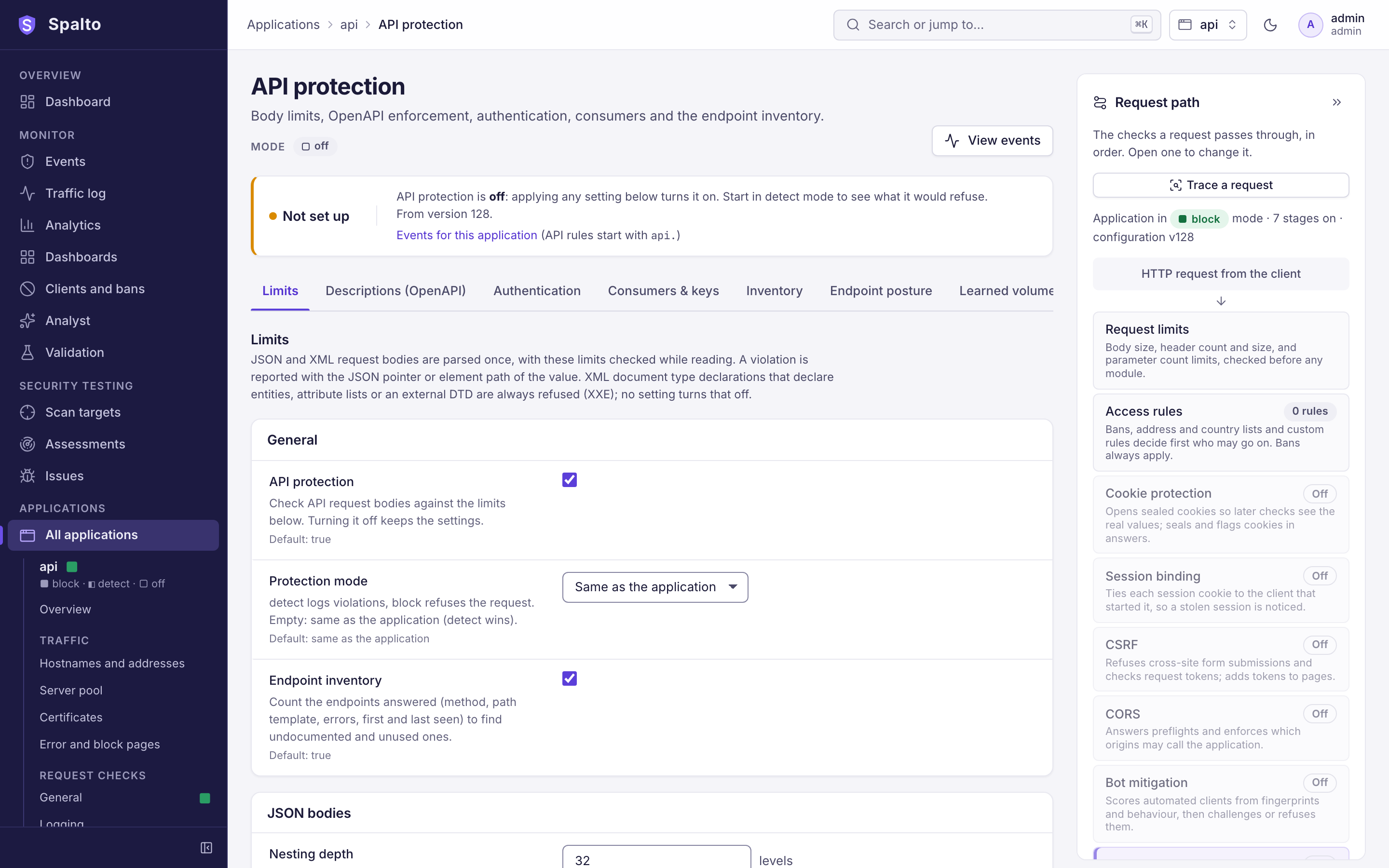
Every API setting in one place, with its default.
Limits, OpenAPI descriptions, authentication, consumers and keys, inventory and endpoint posture each have their own tab. Every field shows its default and its range, so you know what you're changing.
Start in detect mode to see what it would refuse.
Contracts
Check the shape of every call.
- OpenAPI and JSON schema
- Validate requests against your OpenAPI description or a JSON schema, with size and nesting limits for JSON and XML.
- XML and SOAP
- Validate against WSDL, XSD or DTD contracts. Document type declarations that define entities or load an external DTD are always refused, so XXE stays closed.
- GraphQL, gRPC, WebSocket
- Query depth and cost limits for GraphQL, method and message checks for gRPC, message checks for WebSocket, and tool limits for MCP.
- Errors point at the value
- A violation is reported with the JSON pointer or XML element path of the value that failed.
Callers
Know who's calling.
- JWT
- Validation with keys from a JWKS endpoint.
- API keys and consumers
- Keys belong to consumers, with per-consumer rate limits and revocation.
- SOAP signatures
- Signature verification and signature-wrapping detection.
- Client identity
- Limits and events can follow a client by cookie, header, API key or fingerprint instead of by IP address.
Abuse
Catch the requests that look valid.
The OWASP API Top 10 is mostly about logic, not syntax. These checks look at who is asking for what.
- Object ownership
- Detects one user reaching objects that belong to another (BOLA, IDOR).
- Business flows
- Spots skipped steps, the wrong order, excessive speed and one-time values used twice.
- SSRF guard
- Checks request values for server-side request forgery, and offers an outbound proxy for your application's own calls.
- LLM endpoints
- Checks for prompt injection, token cost and leaked secrets, and finds shadow MCP servers and AI agents.
Want to put it in front of your own apps?
There's no public release yet. If you run web applications or APIs and want to try Spalto in a lab, or help shape it, write to us. A person answers.