Platform
Three parts. Each does one job.
Envoy carries the traffic. The inspection service decides what happens to each request. The control plane holds the configuration and pushes it to both. All of it ships as one waap binary and a pinned Envoy build.
One request
What happens between the client and your app.
Five steps, and every one of them shows up in the event if the request is stopped.
- 1
Envoy takes the connection
It ends TLS, parses HTTP and refuses anything over the limits you set (header count and size, body size, slow clients) before inspection even starts.
- 2
Envoy asks the inspection service
Over Envoy's external processing filter (ext_proc), as gRPC on a local Unix socket. Request headers and the buffered body go across. Response headers go too. The response body only goes when a response check needs it.
- 3
Modules run in a fixed order
Access rules first. Then cookies, sessions, CSRF and CORS, bots, API authentication, rate limits, API schemas, file uploads, the learned model, ownership, flow and SSRF checks. Then the signature engine and custom score rules. The console shows the order for each app.
- 4
A verdict comes back
Allow, block (with a block page that carries the event ID), challenge, or rate-limit. In detect mode the request passes and the event says would block.
- 5
Your servers answer
Allowed requests go to the server pool, with load balancing and health checks. Answers can be checked on the way back for data leaks, headers and cookies.
Design choices
Boring where it should be.
Proven parts in the hot path
Envoy is a widely used, well-tested proxy, and Coraza runs the OWASP Core Rule Set v4. Regular expressions run on RE2, which can't backtrack catastrophically. Our code makes the decisions. It doesn't reinvent a proxy.
You choose how it fails
Each application has a failure policy. With fail_open, the default, traffic passes if inspection fails. With fail_closed the client gets a 503. Requests for unknown hosts are always refused. Each module has a time budget, 50 ms by default.
Configuration is compiled, versioned and pushed
Change settings in the console, the API, the CLI or YAML. Every change becomes a version you can diff and roll back. The control plane pushes it to Envoy over xDS and to the inspection service, with no restart.
A few layouts, done properly
One node. The three roles as separate services on one host. Or an active/standby pair with a floating address and mutual-TLS replication. Spreading roles across several hosts isn't supported yet.
The console
One place to run it.
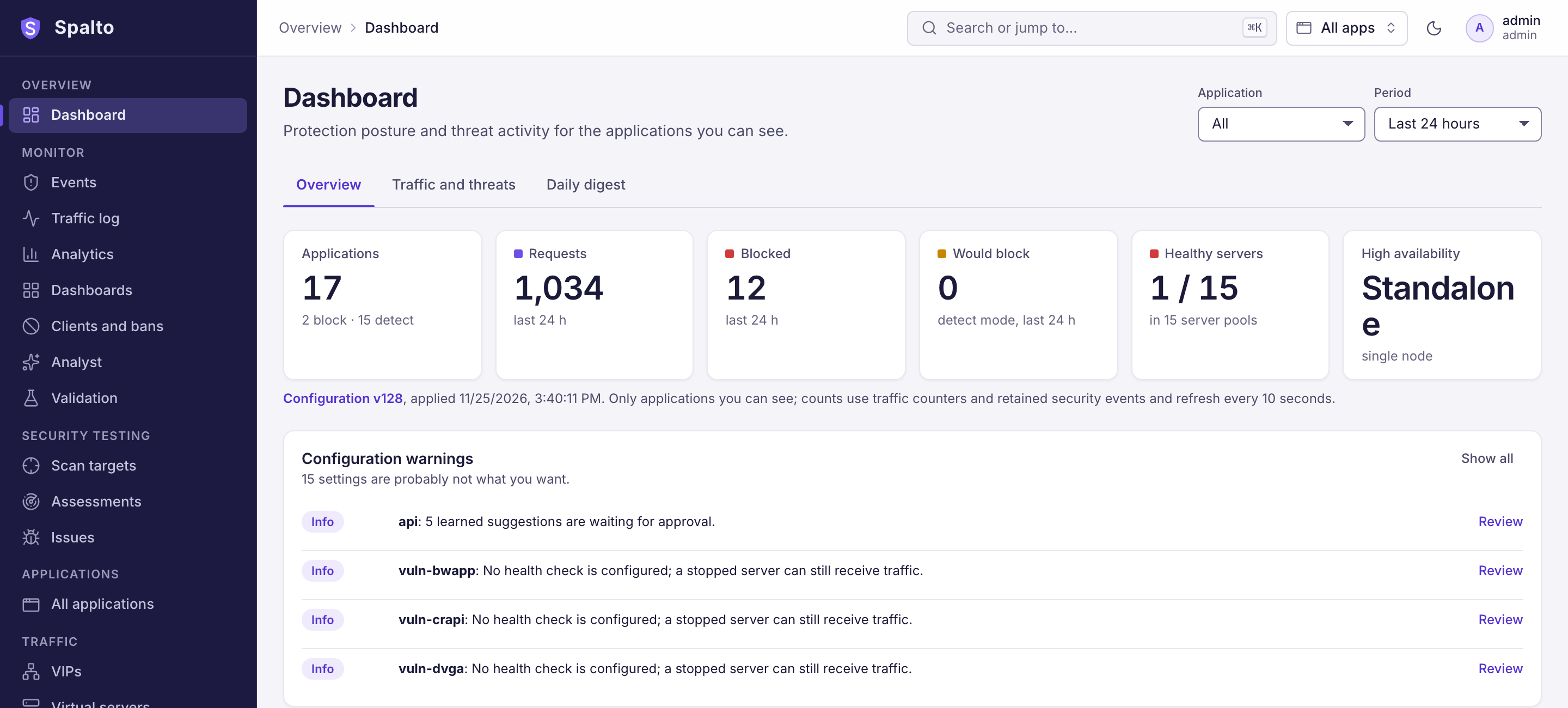
Every application, its mode, its health and its warnings on one screen. The console is embedded in the binary, so there's nothing extra to deploy, and it has light and dark themes.
Under the hood
What it's made of.
The docs explain every stage in depth.
- Data plane
- Envoy, a pinned build, configured over xDS (go-control-plane)
- Signatures
- Coraza v3 with OWASP CRS v4, RE2 through coraza-wasilibs, libinjection
- API checks
- kin-openapi, JSON Schema, gqlparser, jwx for JWT, CEL for custom expressions
- Control and inspection
- Go. One binary with run, control and inspect roles
- Storage
- SQLite
- Web console
- React, TypeScript and Vite, embedded in the binary
Want to put it in front of your own apps?
There's no public release yet. If you run web applications or APIs and want to try Spalto in a lab, or help shape it, write to us. A person answers.